Sunday, November 10, 2019

Climate Change


Melting Arctic ice may be causing a deadly virus to spread in marine mammals


A deadly virus is rapidly spreading among marine mammals in the Arctic. In a new study published Wednesday in the journal Nature, scientists have found a link between the disease and melting sea ice due to climate change. 
Phocine distemper virus (PDV) has been a known pathogen in certain seal populations for decades, resulting in several mass mortality events involving tens of thousands of animals since 1988. Similarities in the outbreaks lead scientists to question how the virus was circulating in seal species all over the globe.
When the virus started to spread across species of otters, seals and sea lions in the northern Pacific Oceans, scientists thought melting ice could be the culprit. 
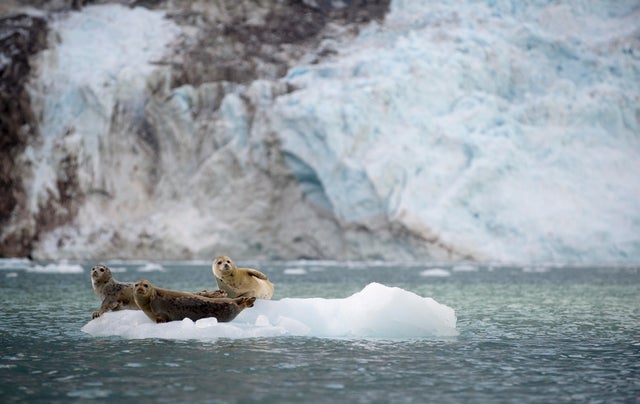
Harbor Seals Sit on an Ice Flow in Alaska
Researchers studied 15 years of data that tracked 2,500 marine mammals in a variety of locations via satellite to find if upticks in PDV matched with declines in sea ice. They also studied measurements of Arctic sea ice over the same time period and examined blood and nasal swab samples from 165 dead ice-associated animals. 


Climate Change 

In one case, scientists found a record amount of sea ice melt in August 2002 was followed by a widespread outbreak of PDV in North Pacific Steller sea lions in 2003 and 2004. During those years, over 30% of the animals tested positive for the virus. 
"The loss of sea ice is leading marine wildlife to seek and forage in new habitats and removing that physical barrier, allowing for new pathways for them to move," author Dr. Tracey Goldstein told BBC News. "As animals move and come in contact with other species, they carry opportunities to introduce and transmit new infectious disease, with potentially devastating impacts."
Melting sea ice has been one of the clearest indicators of over the last few decades. 
According to a recent report by the Intergovernmental Panel on Climate Change, the planet has reached a tipping point where some of the more severe consequences of climate change can no longer be avoided. Ice in Greenland, Antarctica and other mountain glaciers around the world is continuing to melt at accelerating rates as a result of heat-trapping pollution from human activities. The resulting sea level rise around the world already threatens coastal populations, fish supplies and endangered species. "These sea ice changes in September are likely unprecedented for at least 1,000 years," the IPCC said in the report. "Arctic sea ice has thinned, concurrent with a transition to younger ice. Between 1979 and 2018, the real proportion of multi-year ice at least five years old has declined by approximately 90%." Researchers concluded that melting Arctic sea ice caused by human-driven climate change paved the way for PDV to spread to new regions and infect new populations of marine mammals, especially along the northern
Scientists believe the spread of pathogens could become more common as ice continues to melt, with the increased opportunity to affect more species. 

Sunday, November 3, 2019

Hong Kong Protesters Met With Tear Gas After Attack on Chinese Official News Agency

(HONG KONG) — Anti-government protesters attacked the Hong Kong office of China’s official Xinhua News Agency for the first time Saturday after chaos broke out downtown, with police firing tear gas and demonstrators hurling gasoline bombs as the protest movement approached the five-month mark.
Streets in the upscale Causeway Bay shopping area and nearby Victoria Park were clouded in tear gas, prompting thousands of protesters to flee as riot police moved swiftly to stymie a rally demanding meaningful autonomy after Beijing indicated it could tighten its grip on the Chinese territory.
Police deployed at least two water cannon trucks in the vicinity. They had issued warnings to protesters who occupied the area that they were attending an unauthorized rally and violating a government ban on face masks.
Some protesters stormed Xinhua’s office in the city’s Wan Chai neighborhood. They smashed its glass door entrance and windows, splashed red ink, sprayed graffiti and set a small fire in the office lobby
Chinese banks and businesses linked to China have been frequently targeted by protesters as anger has built up against Beijing. The demonstrators accuse the central government of infringing on the freedoms guaranteed to Hong Kong when Britain returned the city to China in 1997.
Earlier Saturday, some protesters unearthed a goal post from a soccer field and metal railings to block the park’s entrance.
Pro-democracy candidates running in this month’s district council elections — who can meet with groups of 50 or fewer people without a police permit — held hustings at the park to try get around the rally ban. One candidate was pepper-sprayed in the face after he argued with police and was detained.
Hardcore protesters in full gear quickly regrouped in the vicinity, using plastic cones and metal railings to set up road barriers. In Wan Chai and other areas, protesters hurled gasoline bombs at police, who responded by firing more tear gas and a water cannon. A number of protesters were detained.
Police said in a statement that some masked rioters also damaged shops, committed arson and placed nails on the roads, threatening the safety of road users.
The chaos underlined the depth of dissent that began in early June over a now-shelved plan to allow extraditions to mainland China but have since swelled into a movement seeking other demands, including direct elections for Hong Kong’s leaders.
A move last month by Hong Kong’s leader, Carrie Lam, to invoke emergency powers to impose a face mask ban was seen as crimping the protesters’ rights to assemble.
As the street battles continued late Saturday, thousands gathered at a public square overlooking the city’s harbor for a police-approved rally. Some carried American flags to press for the passage of a U.S. bill that could place diplomatic action and economic sanctions on the city over human rights violations. U.S. lawmakers have passed the bill, which still needs Senate backing.

Kartarpur corridor


Kartarpur corridor opening for India’s Sikhs in November

Welcome


Welcome
KARTARPUR: A corridor for Indian Sikh pilgrims travelling to a shrine in Pakistan will open in early November, in time for one of the religion’s most sacred festivals.
The visa-free border crossing from India to Kartarpur, Pakistan, would be inaugurated on Nov 9, just ahead of the 550th birth anniversary of Sikhism founder Baba Guru Nanak on Nov 12, Pakistani project director Atif Majeed said on Monday.
The project is a rare recent example of cooperation between the two nuclear powers, who came close to war in February following a militant attack on police in India-held Kashmir. India revoked the special status of its portion of the disputed territory last month, inflaming relations once again.
The Sikh minority community in India’s northern state of Punjab and elsewhere has long sought easier access to the temple in Kartarpur, a village just over the border in Pakistan. The temple marks the site where the guru died.
To get there, travellers currently must first secure hard-to-get visas, travel to Lahore or another major Pakistani city and then drive to the village, which is just four kilometres from the Indian border.
Instead of visas, the Sikh pilgrims will be given special permits to access the shrine.
Indian pilgrims will pay Pakistan $20 to use the corridor, which includes roadways, an 800-metre bridge over the River Ravi and an immigration office.
Up to 5,000 Indians will be allowed access daily, with plans to eventually double the capacity, Majeed said.
Published in Dawn, September 17th, 2019

IMPORTANT

DG ISPR POSTED..............................................................

Major General Asif Ghafoor was commissioned on 9 Sep 1988 in 87 Medium Regiment. He is graduate of Command & Staff College Quetta, Co...